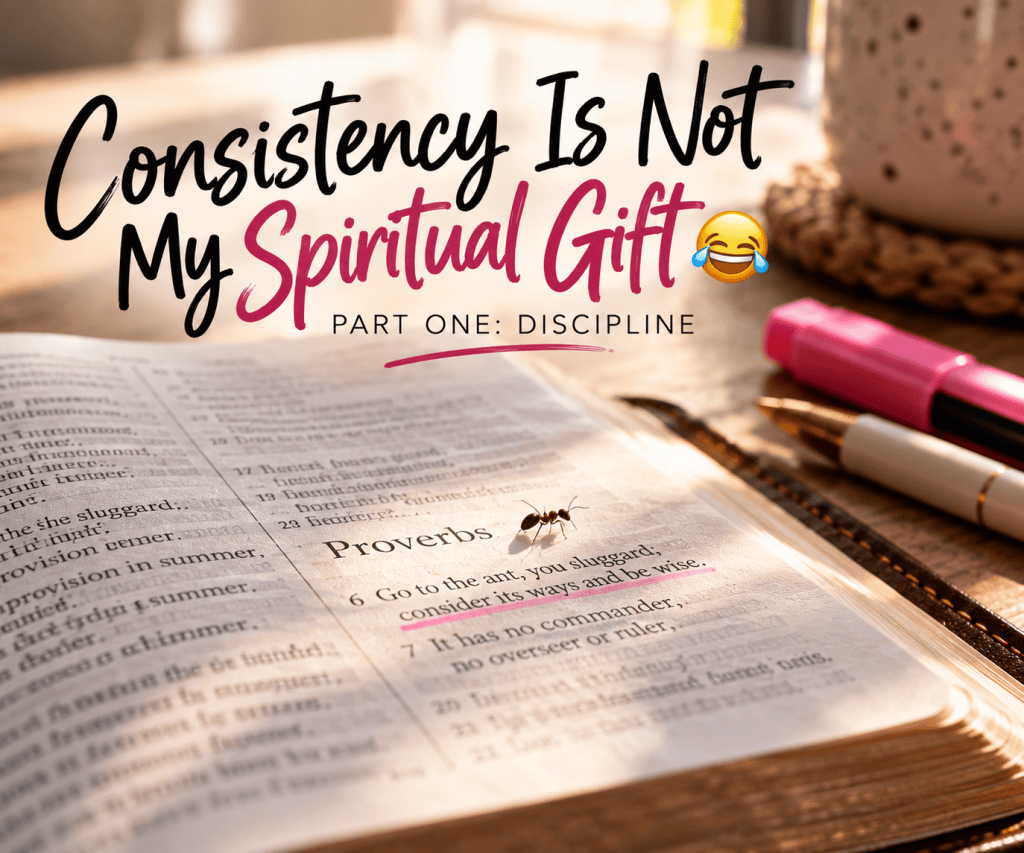
Part One: What the Bible Is Teaching Me About Discipline
I’ve been keeping track of areas in my life where I struggle, especially with self-control and motivation.
And after seeing the same pattern show up approximately four hundred and twelve times, I finally had to admit something:
I reckon we have a discipline problem.
I can get FIRED UP about something. I can make the plan, buy the notebook, research the thing, and convince myself that this time I have absolutely cracked the code.
And then eventually…
I don’t feel like doing it anymore.
So I wanted to know:
What does the Bible actually say about discipline?
I did what I was taught to do. I opened my Bible to the index in the back and started looking.
Except I looked up disciple instead of discipline.
Off to a strong start.
So, like any millennial faced with a problem the Bible index did not immediately solve for me, I Googled it.
That search led me to several passages. And once I started reading them, I noticed something:
They connect.
Apparently my little study on motivation has become a whole thing.
So… here we are.
Apparently, I Need to Learn from an Ant
Proverbs 6:6–11 tells the sluggard to consider the ways of the ant and become wise.
An ant?
What could an ant possibly teach me about human life?
Apparently quite a lot.
The ant prepares what it needs even though it has no commander, overseer, or ruler standing over it telling it what to do.
And that got me.
Because one thing discipline seems to require is learning to recognize what needs to be done and faithfully doing it without always needing outside pressure—or even my own feelings—to make me act.
Then I got to Proverbs 13:4.
The sluggard craves but has nothing, while the diligent are richly supplied.
Ouch.
Because I am VERY capable of wanting something.
I can want with the best of them.
I can want to be more consistent. I can want a cleaner house. I can want to know my Bible better. I can want to finish what I’ve started.
But wanting something isn’t the same as diligently working toward it.
And Proverbs 14:23 took it one step further: there is profit in labor, while mere talk leads toward poverty.
Babycakes, I can plan.
Give me a notebook and some cute pens and I will organize my way into feeling extremely productive without technically producing anything.
Eventually, I have to put the pen down and do the dang thing.
Discipline Requires Training
Then I got to Paul’s letters, and another word kept showing up:
Training.
In 1 Corinthians 9:24–27, Paul compares his Christian life and ministry to an athlete running a race.
Athletes don’t just show up on race day and hope for the best.
They train.
They practice self-control.
They know what they’re running toward.
That made me ask:
What am I actually running toward?
Because maybe discipline isn’t about constantly forcing myself to do more.
Maybe it’s about knowing what matters enough to train for.
Then I read 1 Timothy 4:7–16, where Paul tells Timothy:
Train yourself for godliness.
Practice.
Devote yourself.
Persist.
And then there was one little word that changed how I was looking at this whole thing:
Progress.
Not instant arrival.
Progress.
Maybe I’ve spent too much of my life believing discipline is something you either naturally possess or you don’t.
I’ve looked at consistent people and thought:
Well, that’s just how they are.
Meanwhile, Scripture is using words like train, practice, persist, progress.
Those are process words.
Train → Practice → Persist → Progress
And Then Galatians Kept Me from Yelling at Myself
Thank the Lord I eventually landed in Galatians 5, because otherwise I could very easily turn this entire study into:
GET IT TOGETHER, JANE.
But that’s not the whole picture Scripture gives me.
Galatians contrasts the works of the flesh with the fruit of the Spirit and tells believers to walk by the Spirit.
And among that fruit are two things I’m sitting here trying desperately to figure out:
Faithfulness.
Self-control.
Well, shoot.
The Bible tells me to train myself for godliness, practice self-control, work diligently, and persevere.
But it also tells me that faithfulness and self-control are fruit of the Spirit.
So biblical discipline can’t simply mean gritting my teeth hard enough until I become a better person.
And that’s where I realized:
I have more studying to do.
Faithfulness When Nobody Is Watching
A few other passages added pieces to the picture.
Colossians 3 challenged me to think about working wholeheartedly for the Lord rather than making human approval the reason for my effort.
Romans 12 connects diligence with love, honor, spiritual fervor, and serving the Lord.
And 2 Thessalonians 3 warns against willful idleness, tells people to work quietly, and then says:
Do not grow weary in doing good.
There it is again.
Keep going.
Biblical discipline isn’t looking like frantic productivity to me.
It’s looking more like purposeful, faithful action that continues even after the initial burst of motivation disappears.
So… What Am I Actually Learning?
I started this study thinking my problem was motivation.
But maybe I don’t always need more motivation.
Maybe I need to grow in faithfulness.
Motivation asks:
“Do I feel like doing this?”
Discipline is teaching me to ask:
“What is the faithful thing to do, whether I feel like doing it right now or not?”
And so far, here’s the pattern I’m beginning to see:
INSTRUCTION
I need God’s truth to teach and correct me.
↓
PURPOSE
I need to know what I’m pursuing and why it matters.
↓
TRAINING
I intentionally practice instead of expecting growth to happen overnight.
↓
SELF-CONTROL
I don’t have to obey every impulse, appetite, distraction, or desire.
↓
ACTION
Wanting, planning, researching, and talking cannot replace doing.
↓
PERSEVERANCE
I keep going when the initial motivation disappears.
↓
PROGRESS
Faithful practice produces growth over time.
And I could make myself a cute little chart, tape it somewhere, and decide:
There we go. Seven steps to becoming a disciplined human.
Except I’d be missing something essential.
The Holy Spirit.
This isn’t supposed to become:
“I just need enough willpower to fix myself.”
Scripture calls me to train, obey, work, act, practice self-control, receive instruction, and persist.
But Scripture also tells me that faithfulness and self-control are fruit of the Spirit and tells me to walk by the Spirit.
I don’t want to separate my effort from dependence upon God.
And that leaves me with some new questions.
What does Scripture actually mean by diligence?
What does it mean to walk by the Spirit?
What is my responsibility, and what is God doing in me?
And maybe the biggest one:
What happens when I fail?
When I miss the day?
Drop the habit?
Get distracted?
Get lazy?
Is faithfulness never falling off in the first place?
Or is part of faithfulness learning how to return when I do?
I don’t know yet.
And I don’t want to pretend I do just because I need a tidy ending for a blog post.
So maybe the question I’ve been asking—
“How do I become more motivated?”
—isn’t quite the right question.
Maybe the better question is:
“How do I become faithful in doing what God has called me to do, even when I don’t feel motivated?”
That’s what I’m taking with me into Part Two.
Apparently I have some more reading to do.
And possibly another date with the Bible index.
I’ll try to look up the right word this time.
Grace for the mess. Grit for the rest. 💗




Leave a comment