Calamity, Meet Jane | Open Your Bible With Me
Have you ever forgiven somebody and then found yourself upset about something they did years ago?
Not because you’ve been sitting around keeping score.
Not because you’ve been rehearsing an argument in your head for the next family gathering.
But because you’re just minding your own business, doing something completely ordinary, and a memory pops up.
And suddenly, something clicks.
Well, THAT explains a lot.
Wonderful.
Another thing I didn’t know I needed to work through.
Babycakes, I thought forgiveness was supposed to help us move forward.
Nobody mentioned that sometimes the memories come with additional information.
I’m not talking about digging through the past looking for reasons to be upset. I’m talking about those moments when something you thought you understood suddenly looks completely different.
Now you’re not just remembering what happened.
You’re realizing another way it hurt.
And what exactly are you supposed to do with that?
I Meant It When I Said I Forgave
There was a season in my life when someone I trusted hurt me deeply.
I spent a lot of time praying during that season. I prayed for guidance, protection, and help for my family.
And I made the decision to forgive.
I meant it.
I wasn’t standing there with my fingers crossed behind my back, telling God one thing while secretly planning my revenge.
I genuinely wanted to forgive and move forward.
But something happened that I wasn’t expecting.
As time passed, memories would surface.
Things that had seemed ordinary at the time suddenly made sense in a different way.
And sometimes that realization brought a whole new wave of hurt.
I remember thinking, But I already forgave this.
Except I was beginning to understand that I had forgiven the situation as I knew it.
I hadn’t necessarily recognized every way it had affected me.
So there were days when I found myself praying about something I hadn’t even realized was part of the hurt.
Lord, I need help with this part too.
And then another memory would surface.
And apparently this part.
Good grief.
At this rate, I was going to need a filing cabinet.
Apparently, I’m an Onion Now
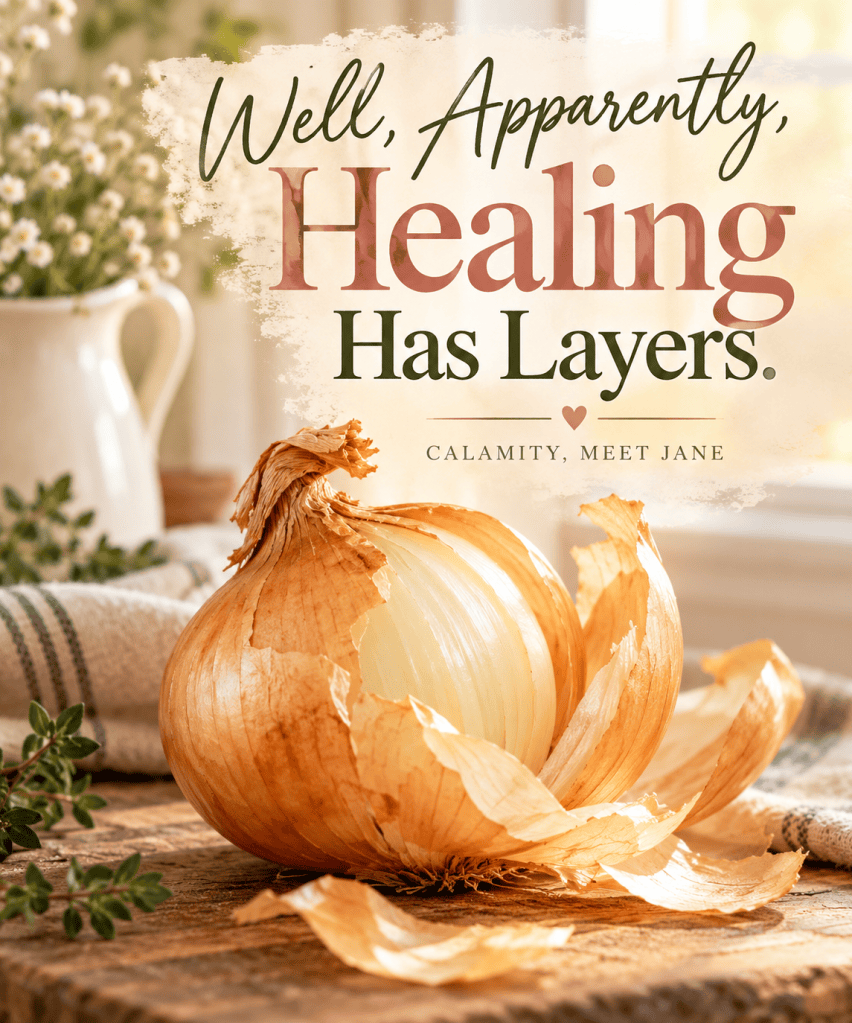
The more I thought about it, the more I realized healing can be a lot like peeling an onion.
You work through one layer, think you’re making progress, and then discover there’s another one underneath.
And another.
And another.
And somewhere along the way, you’re crying.
Which, now that I think about it, makes the onion comparison a little too accurate for my liking.
I can’t say the process has always aPEELed to me.
Sorry. I couldn’t help myself. 😂
But seriously, I started to understand that discovering another layer of hurt didn’t mean the healing I’d already experienced had disappeared.
It just meant there was something else I needed help working through.
And sometimes, I didn’t even know what that something was until it showed up.
David Wasn’t Pretending He Was Fine
This brings me to Psalm 31.
Now, before we go any further, let me say something important.
Psalm 31 isn’t a chapter about forgiving someone who betrayed you. David is praying about his own distress, including enemies who threaten him. We don’t know the exact circumstances behind the psalm.
So I’m not going to pretend David was dealing with the same situation I was.
But there’s something about the way he prays that I recognize.
David says:
“Into Your hand I commit my spirit.” — Psalm 31:5, NKJV
He’s entrusting himself to God.
And then, as you keep reading, you hear how much he’s hurting.
He talks about grief. Fear. Isolation. People speaking against him.
He doesn’t dress it up.
He doesn’t say, Well, I’ve put this in God’s hands, so I suppose I shouldn’t mention how miserable I feel.
Nope.
He tells God.
And then, in verse 14, he says:
“But as for me, I trust in You, O LORD; I say, ‘You are my God.’” — Psalm 31:14, NKJV
That little word but gets me.
David has just described how terrible things are.
But I trust You.
Not because everything is better now.
Not because nothing hurts anymore.
He’s still in distress, and he’s still turning to God.
Now, the psalm isn’t necessarily a timeline of David’s feelings, so we can’t claim he surrendered the same problem over and over.
But we can see that his trust and his pain exist in the same prayer.
And that matters.
Maybe I Had Forgiveness and Healing Mixed Up
I think somewhere along the way, I got the idea that if I had truly forgiven someone, I shouldn’t still be hurt by what happened.
Like forgiveness was supposed to reach back into the past and erase the emotional consequences.
Wouldn’t that be something?
Congratulations! You’ve forgiven. All painful memories have now been permanently deleted.
If only.
But forgiveness doesn’t change what happened.
It doesn’t automatically restore trust.
And it doesn’t mean a relationship is suddenly healthy or safe.
Forgiveness and reconciliation are not the same thing, and neither should be confused with pretending a wrong was acceptable.
I also don’t want to suggest that every painful memory means there’s another forgiveness assignment waiting for us.
Sometimes we’re simply grieving.
Sometimes we’re recognizing a loss.
Sometimes we need support, time, or an honest conversation about what happened.
And sometimes, yes, we may need God’s help to forgive something we’re only now beginning to understand.
I think that’s where I was.
I had made a real decision to forgive, but I was still learning what healing from that hurt would look like.
“My Times Are in Your Hand”
There’s another verse in Psalm 31 that I keep coming back to.
“My times are in Your hand.” — Psalm 31:15, NKJV
David says that while he’s still asking God to rescue him.
He doesn’t have everything resolved.
He still wants help.
He still wants protection.
But he’s entrusting his life to God.
And I think there’s something for us to consider there.
Maybe trusting God with our pain doesn’t mean we have to pretend the pain is gone.
Maybe it means we can be honest about it.
Lord, I thought I was past this, but today it hurts again.
Lord, I want to forgive, but I need help.
Lord, I don’t even know what I’m feeling right now. Can we start there?
Those aren’t quotations from David, of course.
They’re the kinds of prayers I’ve learned to pray.
And Psalm 31 reminds me that bringing distress to God isn’t the opposite of trusting Him.
David does both.
Does It Ever Get Easier?
I wish I could tell you there was one magical morning when I woke up and never thought about that season again.
There wasn’t.
What I can tell you is that the moments became less frequent.
The prayers changed.
Some things that used to overwhelm me don’t carry the same weight anymore.
And some memories can still catch me by surprise.
I don’t think that makes every step forward meaningless.
I don’t think it means I was lying when I said I forgave.
It means I’m a person who went through something painful, and healing hasn’t followed a perfectly straight line.
And maybe you know what that’s like too.
Maybe your story involves a friendship.
Maybe it’s a family member.
Maybe it’s someone who was supposed to protect you.
Whatever the circumstances, I don’t want to tell you that you need to heal on a particular schedule.
Or that forgiveness means you owe someone immediate access to your life again.
Or that God is disappointed every time an old hurt resurfaces.
Psalm 31 doesn’t teach any of those things.
What it does show us is a man who takes his distress to God and continues to place his hope in Him.
And at the end, David says:
“Be of good courage, And He shall strengthen your heart, All you who hope in the LORD.” — Psalm 31:24, NKJV
I love that.
Not because it promises that everything will stop hurting tomorrow.
But because it points us back to the One David trusted in the middle of his suffering.
So if you’ve forgiven someone and an old memory still hurts, maybe don’t rush to accuse yourself of doing forgiveness wrong.
You can acknowledge the pain.
You can ask for help.
You can keep healthy boundaries.
And you can keep turning to God.
Sometimes faith looks like a great big declaration of trust.
And sometimes it looks like sitting at the kitchen table, staring into your coffee, and whispering:
Lord, I need help with this part too.
And babycakes, that prayer counts too.
We can be sincere in our forgiveness and still be healing from what happened.
Now go open Psalm 31 for yourself. Read the whole thing, not just the verses I pulled out.
And tell me, have you ever had a memory surface that made you realize there was another piece of hurt you hadn’t worked through yet?
Let’s talk about it, my hunnies. 💗
— Jane







Leave a Reply